It remembers experiences, not only facts about you
Nosce cares not only about your work, interests, or preferences, but also how a situation felt, what you chose, and what happened afterward.
From the Latin phrase “nosce te ipsum” — know thyself
From knowing yourself to understanding yourself.
Nosce is a long-term AI for understanding yourself. It connects the real experiences you share across time and situations, forming an understanding you can trace to its sources, correct, and watch evolve with you. You can begin with one thing you are living through now.
Currently open to invited seed users.
An illustrative conversation
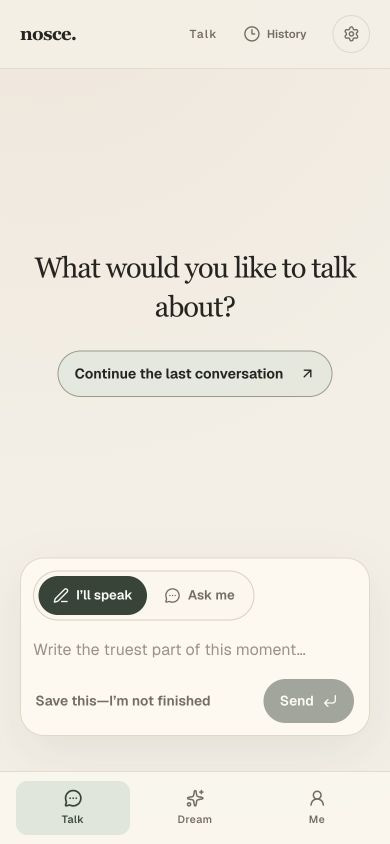
The weight may not be the work alone. It may be having responsibility without enough authorship over what the work becomes.
Why Nosce
Many AI products can remember preferences and personal details to make the next answer feel more relevant. Nosce goes further by organizing real experiences across time, the understandings it forms, and the corrections you make—so you can notice patterns that are difficult to see while living inside them.
Nosce cares not only about your work, interests, or preferences, but also how a situation felt, what you chose, and what happened afterward.
When different experiences support a connection, Nosce says what it currently sees and makes clear what remains unknown.
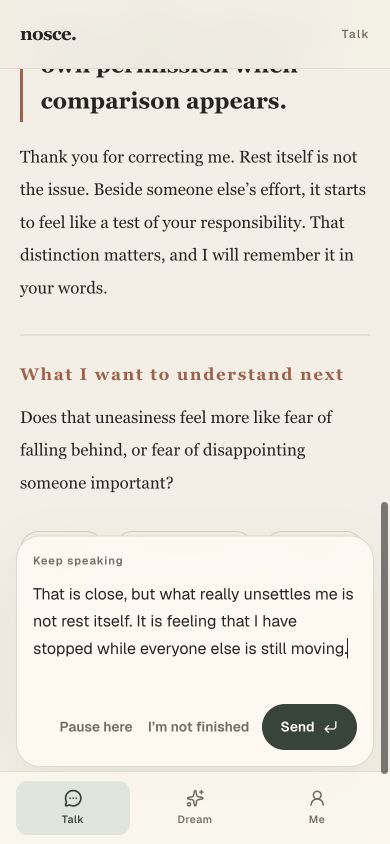
You can inspect where a view came from and say whether it fits, partly fits, or is wrong. Your correction changes how Nosce understands you later.
New experiences may strengthen an earlier view, limit it, or overturn it. Nosce preserves that change instead of leaving only the latest sentence.
You can inspect the source of each understanding and correct, hide, or delete it. You can also export your complete data.
A correction changes the future context
That is not quite right. I can handle disappointment. What I avoid is a conversation where the rules keep changing.
How I understand you right now
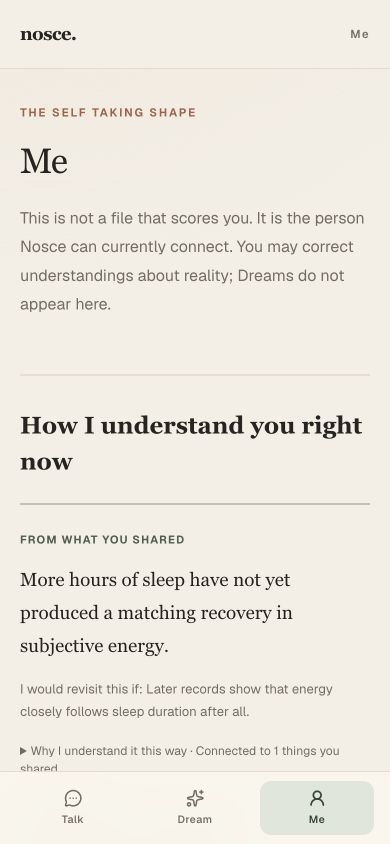
Your energy appears to change less with how much you do than with whether you feel able to shape the direction of what you are doing.
I would revisit this if low energy also appears consistently in situations with high autonomy.
What builds over time
As real experiences accumulate, Nosce organizes them into distinct forms you can inspect: current understandings, an evolving portrait, and a memory history showing how a view was extended or corrected. It is not a personality score or a final answer about who you are.
What do I say first?
Mention something you keep replaying, a choice that felt unlike you, or a change you cannot quite explain. If you do not know where to begin, choose “Ask me” and Nosce will start with one concrete, easy-to-answer question.
Something ended, but I keep replaying it.
I just made a choice that felt unlike me.
Something in me has changed lately, but I cannot explain why.
How Nosce works
Bring one real part of what you are living through. Speak freely, or ask Nosce to begin.
Nosce connects the important details and offers its strongest grounded reading—not a label or a final truth.
Say what fits, what only partly fits, and what it misunderstood. Your correction changes what comes next.
New experiences may strengthen, limit, or overturn what Nosce understood before.
After you leave
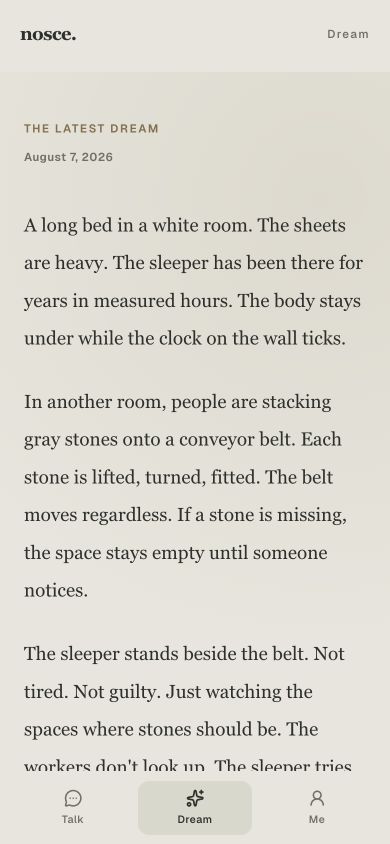
Most AI products end when the conversation closes. Nosce has another layer. After a meaningful conversation, it may form a dream from the person it currently knows.
Some Dreams preserve an unresolved tension. Others quietly rearrange the scene around one possible answer.
Why I built Nosce
For a long time, I summed myself up as a low-energy person. I needed a lot of sleep, my energy shifted across kinds of work, and relationships, pressure, and choice all seemed to affect me—but I treated them as separate problems.
Then I told an AI about these parts of my life in one long conversation. It placed work, relationships, autonomy, pressure, and energy beside one another and helped me see that the scattered reactions might belong to a deeper structure.
The AI did not give me a perfect answer. Some of its claims were too confident. What moved me was that it helped organize something I had been living inside but had never managed to see as a whole.
Nosce began there: not as a replacement for therapy, but as a way for this kind of sustained self-understanding to become more available than one rare, accidental conversation.
Rui — founder of Nosce
Safety, privacy, and control
Nosce Insights
These essays make the product decisions behind Nosce public: what an AI should remember, how its interpretations should be corrected, and where imagination must remain separate from reality.
Remembering facts can make an AI more convenient. Understanding requires episodes, sources, uncertainty, and a history of correction.
Read articleA correction should do more than signal dissatisfaction. It should change the understanding an AI carries into the future.
Read articleA personal AI should preserve how an understanding evolved, not turn an early interpretation into a permanent identity label.
Read articleQuestions worth asking
No. Nosce is a self-understanding tool. It does not diagnose, treat, or replace professional support.
Memory can make the next answer more relevant. Nosce also organizes real experiences, its own understandings, and your corrections over time—so you can see where a view came from, how it changed, and correct it when it misses the point.
No. Nosce can offer a new connection, but it only works with the material you share. You remain the authority who can correct what does not fit.
A dream is a sealed expression Nosce may form when enough meaningful material exists. Some preserve a tension; others embody one possible answer without stating it. A Dream never becomes a fact in your portrait.
The current version is open to invited seed users. Invited users can sign in with the email address connected to their invitation.
Begin here
You do not need to understand it before you begin.
Request seed accessCurrently open to invited seed users.